


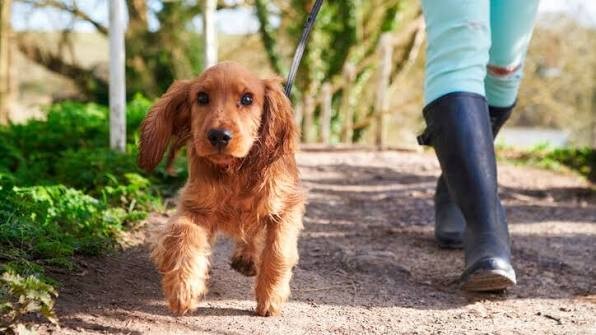
The first few walks with a puppy rarely look the way owners imagine. You picture a relaxed stroll around the neighborhood. The puppy has other plans.
It stops to investigate a leaf. Then a sound makes it turn around. A person appears, and suddenly walking is forgotten. Twenty seconds later, the leash is wrapped around somebody’s ankle while the puppy tries to reach a smell on the other side of the pavement.
It can feel messy, but these early outings are doing important work. A puppy is not simply learning how to walk on a leash. It is discovering how to deal with a world that is much bigger and busier than home.
Give the Puppy Time to Look Around
Adults barely notice many things that are completely new to a young dog.
A garbage truck is loud. A bicycle moves strangely. Somebody opening an umbrella can be surprising. Even walking over an unfamiliar surface may cause a puppy to stop and think.
There is no need to hurry through every moment.
If the situation is safe, let the puppy look. Give it a little time to process what is happening rather than immediately pulling it forward.
Owners exploring puppy training Buda Texas can benefit from thinking about socialization this way. It is not only about meeting people and dogs. Learning to experience ordinary surroundings without becoming overwhelmed matters too.
A Short Walk Can Be Plenty
Distance is not the best way to judge a puppy walk.
An adult dog may cover several miles comfortably, while a puppy can spend fifteen minutes investigating one quiet stretch of neighborhood and come home with plenty to process.
That is okay.
Turning every outing into a mission to reach a certain destination can create unnecessary pressure. Some days may involve more walking. Other days, the puppy may spend much of the time sniffing, watching, and practicing a few simple skills.
The quality of the experience matters more than the number on a step counter.
Pulling Starts With Something Interesting
A puppy does not pull because it has carefully decided to make the walk difficult.
Usually, there is something ahead worth reaching.
Perhaps another dog has appeared. Maybe somebody dropped food on the ground. Sometimes the puppy simply wants to reach a particular patch of grass.
If pulling repeatedly gets the puppy where it wants to go, the habit can become quite effective from its point of view.
Owners can begin teaching a different pattern early. Notice moments when the leash becomes loose and use them to continue forward or allow access to something interesting.
The puppy begins discovering that pulling is not the only way to move through the world.
Practice Before the Street Gets Busy
Loose-leash work does not have to begin in the hardest possible location.
Try a quiet driveway, garden, or calm section of pavement first. Let the puppy become comfortable following changes in direction and paying attention to the person holding the leash.
Once that feels easier, distractions can be added gradually.
Structured dog leash training classes Buda TX can also give owners an opportunity to work on walking skills while learning how to handle distractions and everyday leash challenges.
What matters is giving the dog a realistic chance to succeed before increasing the difficulty.
Not Every Dog Needs a Greeting
Puppies attract attention.
People want to pet them, and other dog owners may immediately ask whether the dogs can say hello. It is easy for a puppy to learn that every person or animal on a walk is a potential social event.
That can become inconvenient later.
Occasionally walking past without greeting teaches another useful lesson: interesting things can exist nearby without needing to be approached.
A puppy can notice another dog and continue walking. It can see a person and remain with its owner.
Those quiet passes are worth practicing.
Know When the Puppy Has Had Enough
A puppy that began the walk calmly may become increasingly distracted after several new experiences.
Listening gets harder. The leash goes into its mouth. Movement becomes frantic, or the puppy simply stops cooperating.
Sometimes the answer is not more training.
The puppy may be tired.
Ending on a reasonable note is often better than pushing through another ten minutes simply because the planned route is not finished. There will be another walk later, and another one tomorrow.
Conclusion
Early walks introduce puppies to far more than a leash. They encounter unfamiliar sounds, surfaces, people, animals, movement, and smells while also learning how to stay connected with their owner.
Keeping outings manageable, allowing time to observe, practicing in quieter places and building leash skills gradually can make those experiences easier for both ends of the leash. Owners looking for professional guidance can visit caninemoxy.com to learn more about available dog-training services and owner education.